The Han Dynasty (206 BC-220 AD)
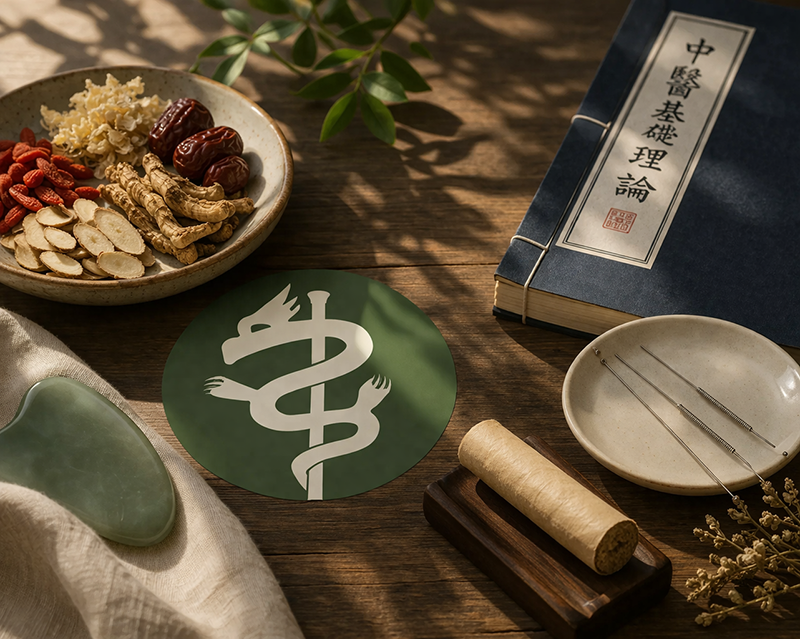
The Han dynasty: the golden age of Traditional Chinese Medicine
If there is one period that can be regarded as the birth time of Traditional Chinese Medicine in its classical form, it is the Han dynasty. From 206 BC to AD 220 — more than four centuries — China experienced unprecedented flourishing in political, cultural, economic, and scientific life. It was in this period that the great classical medical works were compiled, that the theories of Qi, Yin-Yang, and the Five Elements received their definitive systematic form, and that TCM established itself as a coherent, text-based medical tradition.
China becomes a Confucian state
After the short but far-reaching Qin period, the Han dynasty took over. Emperor Gao Zu, the founder of the dynasty, retained much of Qin’s administrative structure but softened its harsh legalism. His successors experimented with a combination of Taoist and legalist principles until Emperor Wu definitively chose Confucianism as the state doctrine. China officially became a Confucian state — a status it would retain until the fall of the empire in 1912.
This choice had far-reaching consequences. Confucian scholars from then on occupied the highest civil offices. Knowledge of the classical texts became mandatory for anyone aspiring to government service. This system stimulated learning and the study of ancient texts — including medical texts. The flourishing of Han medicine is partly due to this intellectual climate.
The Huang Di Nei Jing: definitive systematization
The Han period is the time in which the Huang Di Nei Jing — the Yellow Emperor’s Inner Canon — received its definitive form. Although the texts are older and go back to the Zhou period, they were redacted, expanded, and assembled into one coherent work during the Han era. The Nei Jing lays out the theoretical foundations of everything that defines TCM: Yin-Yang, the Five Elements, organ theory, the meridians, pathology, and treatment principles. Without the Han dynasty, the Nei Jing might never have acquired the systematic form that made it so influential.
Zhang Zhongjing and the Shang Han Lun
Another giant of the Han period is Zhang Zhongjing, often regarded as the "father of Chinese medicine." His work Shang Han Lun — the Treatise on Cold Damage — is one of the most influential clinical works in the history of TCM. It systematically describes the diagnosis and treatment of acute diseases caused by external pathogenic factors and introduces a diagnostic system that still serves as a basis for clinical TCM thinking. The Shang Han Lun was written during one of the great plague epidemics that afflicted the later Han period — proof that medicine in this era was not only theoretical but also highly clinically relevant.
Buddhism arrives via the Silk Road
At the end of the Han period, another historically important development took place: Buddhism entered China via the Silk Road. Originating in India in the sixth century BC, Buddhism had already undergone many transformations before reaching China in the first century AD. In the centuries that followed, it would leave a deep mark on Chinese culture, philosophy, and medicine — adding a new layer to the already rich intellectual foundation of TCM.
The legacy of the Han
The Han dynasty ended in AD 220, but its legacy was indelible. The name "Han" even became synonymous with the Chinese people — to this day, the largest ethnic group in China calls itself the Han Chinese. For TCM, the Han period is the golden age: the time when the scattered knowledge of centuries was brought together, systematized, and committed to writing in works that are still studied and applied today.